

The Wind-Up Universe
Evidence suggests that our universe started inside of a black hole — twisted spacetime may be what drove its expansion

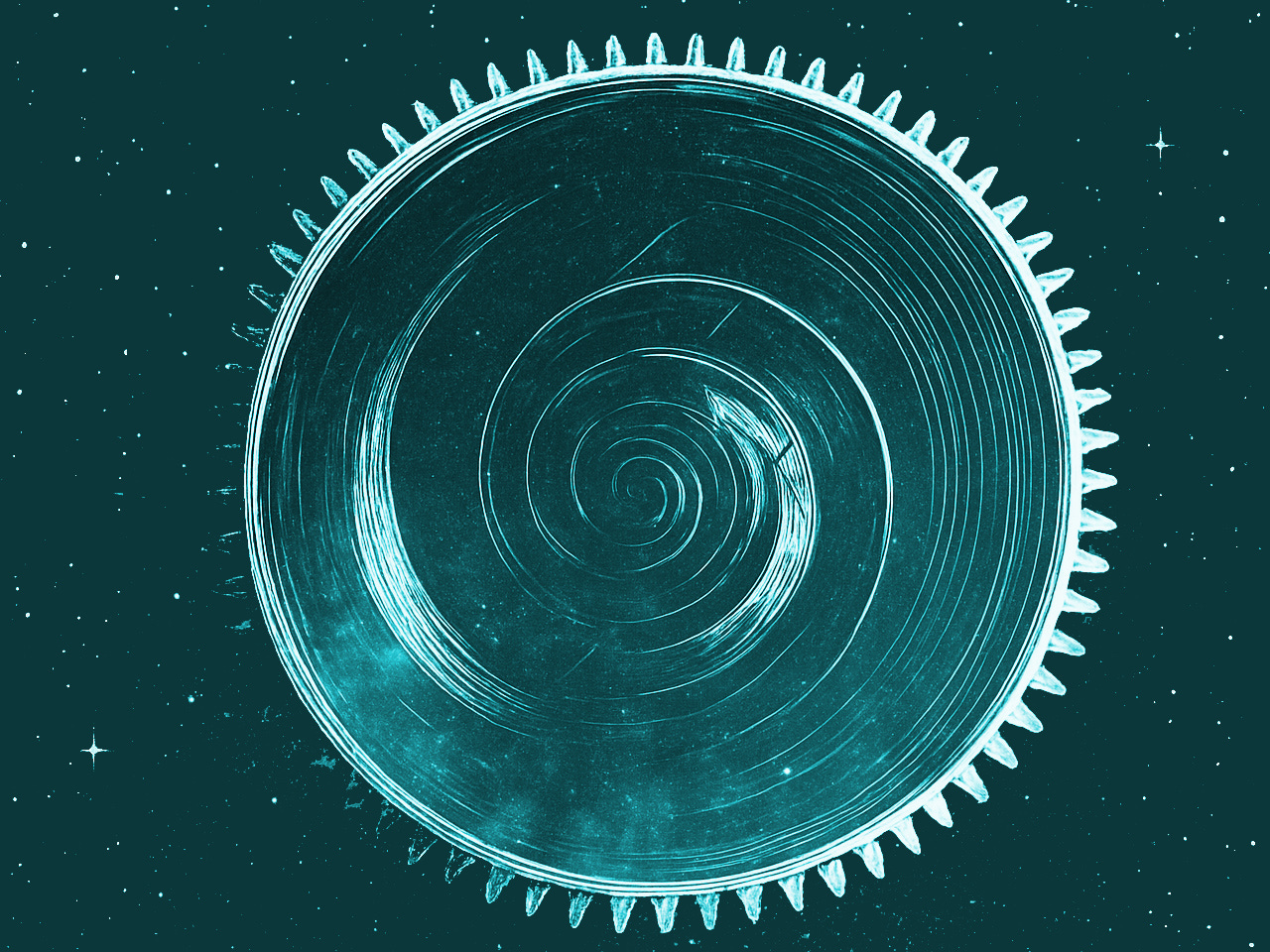
A thought experiment. Imagine an old wooden grandfather clock, its pendulum swinging back and forth, a steady "tick, tock" coming from inside. The mechanism, its metal gears and such, store momentum as energy into its mainspring, heard as the "tock." The release of that energy moves the gears that turn its second hand one "tick," pushing time forward. Now imagine that same mechanism, one that winds and tightens the springs, but at an awesome scale, driven by a mass dense enough to contort space and time itself — a super massive black hole.
Like the clock's pendulum, a black hole may store enormous energy in twisted spacetime, winding a metaphorical mainspring as it collapses in on itself. The release of that energy, like the clock’s “tick,” could trigger something extraordinary: the birth of a new universe within the black hole.
A theory by physicist Nikodem Poplawski may mean we live in this kind of wind-up universe. The theory says that space can be twisted at the smallest of scales, causing it to bounce back like a multi-dimensional spring. The contorted space inside of black holes may also produce new particles and drive the expansion of new universes. This is due to "torsion," or the effect of a twisting force — like winding a mechanical watch. The subtle property of spacetime may be key to understanding the origins of our universe and what might have triggered the big bang. New observations from the James Webb Space Telescope (JWST) support the theory.
A black hole is a cloaked mechanism. Even as scientists learn more about them, they still cannot observe anything beyond their event horizon, the place where the force of gravity becomes too strong for anything, even light, to escape. They were first predicted by the equations of general relativity and were so mind bending that even Einstein was skeptical. He particularity disliked "singularities," the point where mathematics breaks down. When a star collapses into a black hole, all its mass, light, and energy turn inward. The curvature of spacetime (its gravity) becomes infinite, as does its density. The singularity this creates essentially turns physics inside out.
Poplawski explained how this led to his own theory, "Einstein assumed that torsion was zero...in my opinion, that assumption causes singularities.” He thinks black holes don't collapse into singularities due to spacetime torsion. Torsion has no little influence when applied at most scales. Even something like a neutron star, an object millions of times the mass of our own sun, would see no effect. Only in the near limitless destinies near the center of a black hole would torsion come into play. "Torsion comes like a miracle, it does not do anything where we don't need it."
Recent JWST observations published by Kansas State University researcher Lior Shamir support the theory. He examined the rotational direction of over 260 galaxies with the help of AI. Shamir determined that two-thirds of the galaxies in the sample were spinning clockwise, while the rest rotated in the opposite direction, implying that our universe was born with inherent spin. This suggests our universe may have formed inside of a rotating black hole. All black holes spin, some at rates approaching the speed of light.
Rotation tends to produce a repulsive force, like the center of a whirlpool as water spins down a drain. In the 1960s, physicists Dennis Sciama and Tom Kibble showed how torsion resulting from angular momentum might create a similar repulsive force. Twisting space at the tiniest scales may produce a sort of anti-gravity determined by the limit of how tightly space could be twisted. Space has some give to it.
The springiness might lead to the formation of new and expanding space at the center of a black hole. Its edges resembling the whirlpool, new space would fill the gap as it spins. This opens up a wormhole, or an Einstein-Rosen bridge, scientifically. The doorway would lead to a dynamic and expanding space within, hidden from outside observers, unless they somehow passed through. The journey would take the entire lifetime of the parent universe. It would be a one-way ticket.
Poplawski's 2010 paper that first suggested torsion from the spin of black holes could produce a new universe garnered interest among physicists, but there was concern that the repulsive force was not strong enough to beat the sheer force of gravity. He admitted, "Torsion by itself cannot prevent a singularity." He added a new variable to his equations, wondering what would change if particle production was introduced, "that was the last piece of the puzzle."
New particles produced from a black hole isn’t a new idea. Steven Hawking showed how photons could emerge from their event horizons in a process called Hawking Radiation. In the vacuum of space, particles and anti-particles regularly pop in and out of existence, canceling each other out. Picture each as a pair of mechanical counterparts turning in opposite directions. At the edge of a black hole, sometimes one of the gears falls in while the other escapes, disrupting the balance. The broken system produces a new particle, leaked from the edges of a black hole.
Poplawski predicts that new particles emerge from inside of the event horizon too. As torsion fights gravity, an unknown mechanism produces massive amounts of fundamental particles, perhaps in a similar way. Enough particles are produced to overcome the force of gravity. When this type of particle production was modeled with the combined effect torsion, Poplawski found it would not only prevent collapse but bounce back like a spring. "Particle production makes inflation. I didn't plan on that!"
The new JWST data showing how our universe had an inherent spin supports this scenario, but scientists need more evidence. Poplawski suggested looking for a white hole in our universe. "Only one could exist in our universe if my theory's correct," he said. A white hole would be the door that links our universe with its parent. Astronomers have never observed a white hole, but it's theorized to look like the first moments of the big bang, a white-hot radiating source of energy pushing everything out from a central point. Finding a white hole would be a smoking gun.
A wind-up universe might have another signature: periods of oscillation. Depending on the size of the parent black hole particle production would vary. This would produce different sized “bangs.” After inflating for some time, a new universe would eventually collapse, producing more particles before rebounding into a bigger universe. We’d likely see subtle remnants of this in our cosmic microwave background — the mostly uniform energy left over from the big bang.
The oscillations might go through several cycles. "If particle production is very small, you may get twenty bounces." Poplawski thinks a universe like ours is probably on its last bounce, or its "big bounce." He explained, "when the universe becomes big enough, dark energy will prevent a next cycle...such a universe will start expanding forever."
While answering questions from school children in his native Poland, Poplawski recalled he was once asked, "What made the first universe?" Despite all his mathematics and theory, he could only answer with a question. "Maybe we are living in an infinite chain?" If the mechanics of our universe work like wound up mainsprings, then black holes might be more like the gears of an eternal clock. An unfathomable mechanism, wound up by its parent universe, winding countless more. Gears “ticking” time across each ever-thinning bridge. An unwinding multiverse moving time forward through eternity.
List of Sources
Nikodem Poplawski, Teams interview, 07/13/23. NPoplawski@newhaven.edu
N. Popławski. Nonsingular Dirac particles in spacetime with torsion. Physics Letters B, Volume 690, Issue 1. 73-77. (2010). https://www.sciencedirect.com/science/article/pii/S0370269310005691?via%3Dihub
N. Popławski. Universe in a black hole with spin and torsion. Astrophys. J. 832, 96 (2016). https://doi.org/10.1038/s41586-022-04432-7
N. Popławski. Gravitational collapse of a fluid with torsion into a universe in a black hole. Journal of Experimental and Theoretical Physics. 132 (3): 374–380. (2021). https://arxiv.org/abs/2008.02136
Lior Shamir, The distribution of galaxy rotation in JWST Advanced Deep Extragalactic Survey, Monthly Notices of the Royal Astronomical Society, Volume 538, Issue 1, March 2025, Pages 76–91, https://doi.org/10.1093/mnras/staf292
Sciama, D. W. The Physical Structure of General Relativity. Reviews of Modern Physics. 36 (1): 463–469. (1964-01-01). https://journals.aps.org/rmp/abstract/10.1103/RevModPhys.36.463
Kibble, T. W. B. Lorentz Invariance and the Gravitational Field. Journal of Mathematical Physics. 2 (2): 212–221. (1961). https://www.semanticscholar.org/paper/Lorentz-Invariance-and-the-Gravitational-Field-Kibble/58b4aeaa2de802b0d76130899d65dd2b21805651
Hawking, S. W. (1975). Particle creation by black holes. Communications in Mathematical Physics, 43(3), 199–220. https://doi.org/10.1007/BF02345020